Environmental Educator Andrea Dee plays a vital role in educating the Northern Kentucky community about stormwater management. In this edition of Staff Spotlight, Andrea shares more about her role inside and outside of SD1.
Andrea, how would you describe your role?
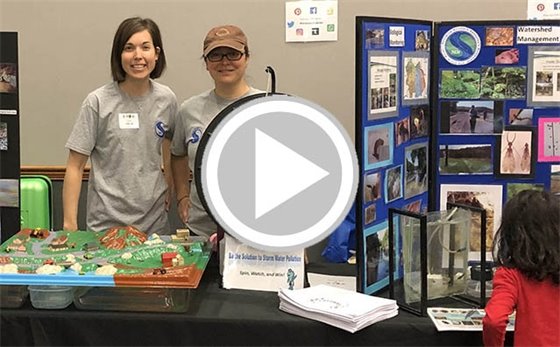
I'm responsible for getting the word out about stormwater management in the community. I work primarily with elementary school programming in Boone, Kenton and Campbell county. Additionally, I serve as the primary point of contact for stormwater education inquiries here at the District. For instance, I facilitate Public Service Park tours for community groups and professionals that want to learn more about SD1's use of stormwater best management practices (BMPs).
What does the stormwater education program involve?
As a stormwater utility, SD1 is tasked with educating the community about stormwater management as part of our permit compliance. We strive to put together hands-on programs that enable people to connect and understand the importance of managing the stormwater system and why they're paying to help manage that system in Northern Kentucky.
Our education program caters to all ages, with a particular focus on educating young learners about stormwater management. It's our goal that as they grow older, they will be able to recognize and understand the system surrounding them, such as how water moves, how to prevent polluting our water resources and how storm water management alleviates the strain on other systems such as roads and buildings. This will help them recognize the importance of proper stormwater management as they grow older.
How has the education program evolved to meet our community's needs?
The education program has undergone significant changes in recent years. The programming, which had been in place for 15 years, was recently revamped by collaborating with local teachers, SD1 scientists and a state science specialist. The result is a new program that better serves the needs of students and teachers.
Here are some key benefits of the new program:
- The use of advanced learning tools, such as digital games and videos, makes learning more interactive and fun for students.
- The program meets or exceeds school standards, ensuring that students are receiving a high-quality education that prepares them for success in the future.
- A new website ensures teachers are more supported and equipped to effectively teach the unit to their students.
- Students now explore concepts in a more hands-on way, using their school as a case study for improving storm water management and preventing water pollution.
We've also taken our standard unit a step further by introducing the Stormwater Challenge. This program engages older students in a case study of their school site where they must identify the most effective stormwater BMP for their school. Through this challenge, they learn about stormwater management and problem-solving skills. The students create presentations to showcase their proposal and present it to community partners for feedback, providing them with a chance to present in front of others and learn how to push a project forward.
What would you say is the most rewarding part of your job?
Without a doubt, the most rewarding part of my job is being in front of curious young minds every time I go out into a school, no matter what the age.
My favorite quote is "The future belongs to the curious." Every time you get in front of students, you experience that. It's encouraging and refreshing to hear young minds already thinking about the future and how to solve problems. These future problem-solvers are always considering ways to engineer and improve our systems. I often share their ideas with my team, and who knows? Maybe one day they'll work at SD1 themselves.
Do you have any interesting stories to share about working with such curious young minds?
Visiting schools to present on stormwater is always a fun experience. During my presentations, I like to briefly explain SD1's role in wastewater management, which never fails to capture the attention of young students. Sometimes, a student will raise their hand, and while you think they want to contribute to the conversation about stormwater, they're still thinking about the sewer system and it all leads to a laugh. They often ask questions like "What happens to a goldfish that's flushed down the toilet?" or "Where does jewelry that's accidentally lost in the sink end up?"
What challenges do you experience?
One word: coordination. When dealing with about 30 different schools and coordinating schedules that include spring breaks, summer vacation, and the start and end of the academic year, scheduling can be a significant hurdle. We ensure that we meet the needs of our partners by carefully managing these logistics. Similarly, we coordinate with community partners and scout groups to ensure that any requests or inquiries are addressed in a timely and efficient manner. I try to stay flexible and make sure that we make it work for everyone.
How does your role help SD1 serve the community?
I share the great resources that we have here at SD1 with the community. For example, our programs, such as DRIP, provide simple ways people can help prevent stormwater pollution by redirecting water or installing a rain garden or rain barrel. Simply by talking with individuals, whether they be young students or adults at a community event I help spread the message that we can all be part of the solution to stormwater pollution by the little changes we make.
What is your favorite part about working at SD1?
My favorite part of working here is definitely the team I work with! I came here and learned so much from them. I had a background in environmental education but not specifically water, so learning from our environmental scientists and our team members about what they do and connecting all those dots and sharing that has been great. We work really well together and we're able to accomplish some big goals because of that. I'm encouraged and thankful to be on a great team.
What do you like to do outside of SD1?
I like to keep moving, whether I'm here or outside of here. Generally, I will be bike riding, kayaking, gardening or cooking. My very favorite thing is to do something new that I've never done before, as long as it's not like super dangerous - I'm not necessarily a huge scary thrill seeker, but I love trying something new.


 Share on Facebook
 Share on Twitter
 Share via Email
