SD1 has begun printing its own equipment components to significantly reduce the cost of maintaining essential sewer inspection cameras.
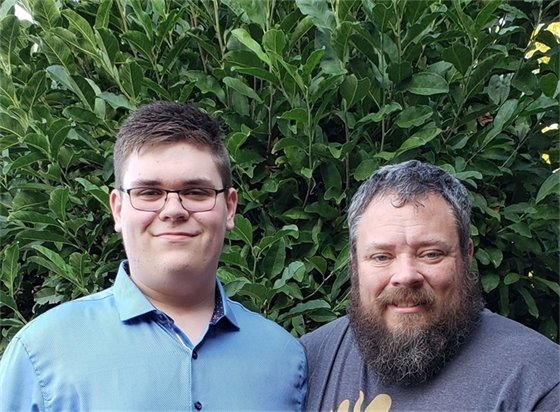
Asset Maintenance Technician Collin Couch and his father, Asset Maintenance Manager Donnie Couth, have partnered on the project, which is expected to save ratepayers thousands of dollars each year.
Sewer inspection cameras play a critical role in maintaining Northern Kentucky’s wastewater and stormwater systems. The specialized cameras work with crawler robots to collect visual data of what is going on inside sewers, allowing SD1 to identify problems and prioritize improvement projects across the region.
SD1 has annually spent thousands of dollars maintaining these sewer inspection cameras.
“Battling the increasing cost of repairing this equipment has been an ongoing challenge,” said Donnie, who has worked with the cameras for decades. “The cost for labor and parts continues to rise.”
To reduce costs associated with outsourcing camera repairs, SD1 implemented an in-house maintenance and repair program several years ago that continually looks for savings within the department. Recently, someone asked if SD1 could 3D print replacement camera parts instead of ordering costly parts from vendors.
“I told him I wasn’t sure,” Donnie said. “But I knew who I could ask.”
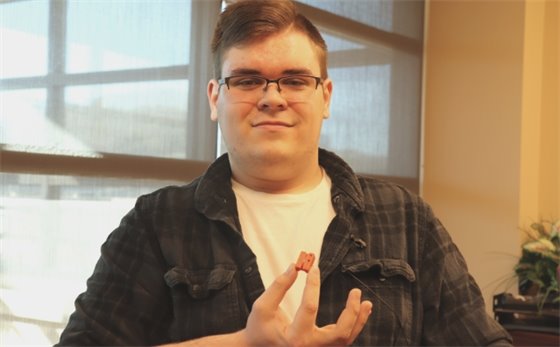
Collin, 20, is a mechanical engineering student at Northern Kentucky University who has been 3D printing since his days at Conner High School. His experience ranges from printing general-purpose items to printing critical replacement parts for home repairs.
Donnie, aware of his son’s ability and interest in 3D printing, brought home a commonly replaced camera part called a passive guide and showed it to Collin, who wasn’t yet working at SD1 at the time. He explained SD1’s goal to reduce costs and asked his son to investigate.
Collin was excited to work on the project. He drew the component in CAD (a 3D modeling program) and produced a 3D-printed passive guide prototype at home. After joining the asset maintenance team, he and other SD1 staff field-tested the prototype, experimenting with different materials and gaining valuable feedback from the camera crews.
After a few months, the team produced a 3D-printed passive guide that works as effectively as the original part that was sourced from vendors – at just a fraction of the cost. The small plastic guide that SD1 had been paying about $650 for was able to be 3D printed in-house for about 30 cents.
The move to in-house printing of this component alone will save SD1 nearly $40,000 annually.
And the District isn’t stopping there. SD1 is preparing to purchase its own 3D printer, which Collin estimates will cost about $1,500.
He and other asset maintenance team members have many other parts in mind for potential in-house 3D printing, which will result in even greater savings.
“I’ve always loved making things,” Collin said. “Being creative at this job and finding new ways to save money and improve SD1's cameras has been a great experience."
Donnie said that Collin’s dedication to innovation and problem-solving is an asset to SD1 and that working on the project will make his son a stronger mechanical engineer.
“This opportunity has allowed Collin and I to see a side of each other that fathers and sons don’t always get to see,” said Donnie. “His ability to dream up or see an item and have the skills and intelligence to design and build it is amazing. His mother and I are very proud of him. I appreciate the opportunity that has been given to Collin by SD1.”



 Share on Facebook
 Share on Twitter
 Share via Email
