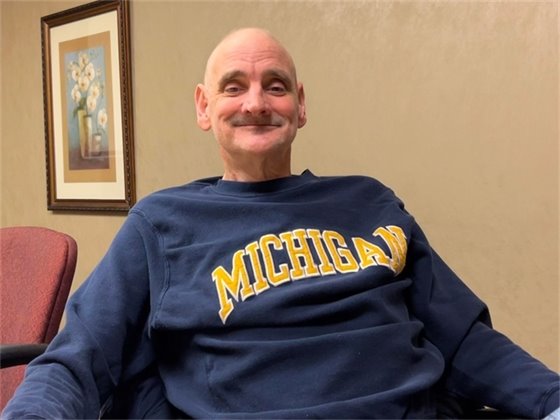
Western Regional Plant Operator Jim Freiermuth will never forget the day before Thanksgiving 2021 when he sat in his doctor’s office and was told, “If you don’t start chemo next week, you’ll be dead by New Year’s Eve.”
Even though he’d known something wasn’t right – Jim had lost almost 50 pounds over the previous year with no explanation and despite numerous inconclusive tests, he’d recently discovered a golf-ball-sized lump on his neck – he wasn’t prepared to hear the words “chemo” or “dead by New Year’s Eve.”
Non-Hodgkin’s lymphoma is a type of cancer that starts in a person’s germ-fighting immune system. Someone with this particular type of cancer has white blood cells called lymphocytes growing abnormally; these can form growths (tumors) throughout the body.
But Jim didn’t know any of that on the day he received his diagnosis. All he knew was that he had a choice to make: live or die.
“I’ve believed for a long time that when you’re born, you’ve got a date and a timestamp put on you of when you’re going to die,” Jim says. “And only the man upstairs knows why.”
For a long time – most of his life, really – Jim was anti-doctor because, as he puts it, “nobody wants bad news.”
And it doesn’t get much worse than the news he received that day last year. His PET scan had come back and, as Jim puts it, “everything was highlighted.” He was in bad shape from his neck to his pelvis.
“But I realized sitting there in the office that day, you know, I can either not care and not go through anything and die,” Jim says. “But I said what’s that going to do to everybody around me? I realized that would be very selfish just to write it off and be gone. So, I said you know, I’m going to fight it. I’m going to go through with it. I’m here for a reason and I’m going to go with it. So, I told the doctor, get it set up.”
A week later, he started chemotherapy. Over the course of the next 12 months, Jim would undergo 10 rounds of chemo – the toughest of which was a 6-day session at UC Health to prepare him for a stem cell transplant he received on October 4, 2022.
Jim says those days at UC were the low point when all he wanted to do was lay in bed. “None of the other rounds of chemo really had that effect on me,” he says, “but that one wiped me out.”
Even then, during the darkest hours of his fight with cancer, Jim was able to maintain a remarkable perspective.
“They encouraged you to get up and walk as much as you can leading up to the transplant,” he says. “And you’d walk down the halls of the hospital, and you can’t help but look in the rooms. It’s human nature. And I’d say, ‘I don’t ever want to be like that. I don’t ever want to be like that. I don’t ever want to be like that.’”
The floor he was on housed only transplant patients, most significantly older than Jim, who turns 60 next month. Seeing the other patients around him made Jim appreciate an advantage he had in his fight with cancer: youth. His situation may not have been optimal, but those around him were facing an even more uphill battle.
“I really took that to heart,” he says. The perspective helped. “I learned to…just be nice. That’s all you have to do,” he adds with a laugh. Jim laughs more than you’d expect from someone in his position.
It’s become almost a mantra to Jim: Just. Be. Nice.
He says not too long after he received his diagnosis, he was spinning out and didn’t even realize it. One day, he was talking to a neighbor and suddenly realized he was getting “snappy” with her. “I imagine it was the result of everything going on inside,” he says. “And she said, ‘What is wrong with you? We’ve been neighbors for 22 years. This isn’t like you at all.’ And I learned right then and there – if I’m being like this to my neighbor, how am I to my coworkers? My family? My friends? And that’s something that had never occurred to me. So, I changed my mindset right there and said you’ve got to remain positive because other people were noticing and I wasn’t. So…stay positive. That’s the key to the whole thing.”
He says of course there have been ups and downs. During that last round of chemo, he could hardly walk. “But I learned very swiftly that you have to keep a positive outlook on things,” he says. “Because if you’re all negative, it not only brings myself down but everybody around me. And thank goodness for my two sisters, because they helped me out tremendously getting me back and forth to appointments. And I have a core group of friends. And of course my coworkers – they were always checking up on me. And I’m not going to mention any names because for sure I will leave somebody out and that would not be good. But as a whole, SD1 has been nothing short of incredible. I have never worked for a better group of people. It’s been great.”
Jim had a stem cell transplant in October, and since then has been home recovering. A follow-up PET scan in mid-November came back with just one small spot showing up on his sternum. He said the doctors think that may be related to his last round of radiation, or that it could even be normal because it’s such a small spot – maybe a centimeter in diameter.
He met with the oncologist a couple weeks before Christmas and the doctor could tell Jim had something on his mind. “I told him I really want to go back to work,” Jim says. The doctor said that would be fine as long as Jim was careful. (He can’t get all of his vaccinations again until January.)
He returned to work on December 26 after a 13-month leave to fight the Non-Hodgkin’s lymphoma. He says while he was away, he missed the camaraderie at SD1 and the family-like feeling. “I’ve never met a nicer group of people to work with,” he says. “It’s been phenomenal. If I didn’t like it, I wouldn’t still be here!
“I’m looking forward to getting back into the swing of things,” he adds. “A normal life. You can only watch so much TV and then you’re done with it. I’m sure there are several things that I have forgotten just because I haven’t done it in awhile, but I’ll catch back on very quickly. I’m a fast learner. And if I get tired, I’ll sit down and stop for awhile and then go back to it.”
He also has a message for his coworkers at SD1: call him if you need support.
“We’re all connected to cancer somehow,” he says. “Either someone you’re related to or someone you know has gone through it. My birth mother had cancer, my aunt had cancer, my grandfather had cancer. So somewhere in the circle of life, you know somebody that’s affected by it. And it’s not discriminatory; it affects whoever it’s going to affect for whatever reason. I still to this day don’t know – and the doctors don’t know – why it happened.
“So, if you’re going through something like that and you need to talk to somebody, give me a call or shoot me an email,” he says. “I’ll be more than happy to talk to anybody who may need some assistance or maybe just an ear to lean on. Support is very important.”


 Share on Facebook
 Share on Twitter
 Share via Email
