It’s a beautiful morning in Hopkinton, Mass., a small town exactly 26 miles and 385 yards outside of Boston. The temperature is nearly 50 degrees with zero percent precipitation and 34 percent humidity. There’s a slight breeze. Yes – April 18, 2022, is shaping up to be a nice day for a run.
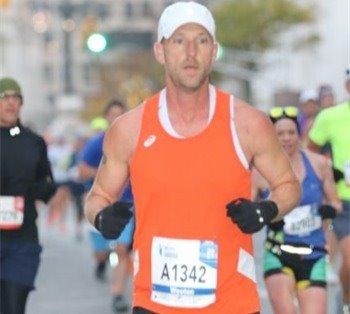
Matt Wooten gives his legs a final stretch before setting off. The bib pinned to his shirt reads No. 12388. He’s one of about 25,000 people competing in today’s Boston Marathon.
And while the next three hours will be challenging, they’ll be nothing compared to the road that led him here.
A Seed is Planted
Matt discovered a love of running as a student at Boyd County High School in Ashland, Ky. He wasn’t on the cross country or track team – Matt was a baseball player.
“My coach had a conditioning program that he got from the cross-country coach that involved us doing a lot of different running,” he says. “We would run 400s (meters) and 800s, which culminated in a mile. In order to make the varsity team, we had to run a 6-minute mile. So there was a lot of training that went into that.”
He worked hard and eventually got his mile time under 6 minutes, a feat he can still accomplish today. “That 6-minute mile has always stuck in my head,” Matt says. “And here we are 31 years later and I can still do it. I wasn’t always able to do it over those 31 years, but I could when I graduated and I can now.”
The seed was planted, and Matt has run recreationally ever since. He ran his first organized race, a 5K (about 3.1 miles), about 20 years ago. Over time, his distances began to climb and in 2009 he decided to sign up for Cincinnati’s Flying Pig Marathon.
“The Pig is a really hard marathon,” he says. “I can’t say I’d recommend that be your first one. It is hilly; the first half of that race is rough.”
He finished in 4 hours and 17 minutes, a respectable time for a guy in his mid-30s. As he crossed the finish line that day, Matt figured it would be his only marathon. “I said to myself I’m never doing that again,” he says.
And for a while, it looked as though he might have been right. Recovery from the race took about a month, and he decided to stick with shorter races for the next several years. But over time, he got in better shape and started running half marathons (13.1 miles) because training was easier for that “manageable distance.”
“I was doing pretty good and was starting to cut my half marathon time down a little bit,” Matt says. That’s when a thought popped into his head – could he run a marathon in under 4 hours? “I think I was challenged by somebody – someone said I couldn’t do it, which is a good way to get me to do it.”
It wouldn’t be easy. He would have to shave 17 minutes off his time, which is a fairly substantial cut. And by the time he signed up for his second marathon – the ING Miami Marathon in January 2012 – Matt was knocking on 40 years old.
A Run in the Sun
An environmental program manager at Sanitation District No. 1, Matt trained through the fall of 2011, and headed to Florida to run the race with his co-worker, Craig Frye.
“I was thinking it would be a nice flat marathon,” Matt says. “But I wasn’t anticipating it being 75 degrees at 6:30 a.m., when the gun sounded. I’d been training up here all fall and winter; my last training run, it was 32 degrees. I go down and in Florida it’s 75 degrees at the start.”
He did manage to break 4 hours, but the race was grueling. “It was really hard,” he says. “My legs were really cramped. I told myself again that I was never going to do that again.”
It’s important for a runner to reward himself after a big race. Matt’s post-marathon ritual helps to ease the suffering. “I have a weakness for really good cheeseburgers,” he says. “So I usually find the biggest, fattest cheeseburger that I can lay my mouth on and I eat every bite of it with french fries … and I don’t feel a bit guilty.”
Though he’d once again sworn off marathons, Matt kept his running up. “I’ve always run, always been kind of a runner,” he says. “I’m an active guy; I just enjoy getting out and running. It helps me clear my head and keep my sanity. You can really clear your head when you’re out there on the course or even out there on the road. Just think about things and sort things out.”
A Challenge Leveled
He started going on lunchtime runs with other SD1 coworkers, Jason Burlage and Matt Van Doren. They’d set off down Madison Pike in Fort Wright, pushing each other to new levels.
“Van Doren was a pretty big motivating factor for us,” Jason says. “Just his approach and consistency. I think Wooten owes a lot to Van Doren and his last year here before he left. He forced Matt to do the speed work that he never really did in the past – you need the speed work in addition to those long, plodding miles.”
Matt says discussion on these lunchtime runs eventually turned toward Boston.
“So I’m out there running with these guys regularly, and through the back-and-forth – you can imagine there is a lot of conversation on these longer runs – Jason was like, ‘We should try to qualify for Boston!’ And I said, ‘Dude, the qualifying time for me is 3:20. I’d have to shave 40 minutes off my best time.’
“But Jason kept pushing, you know?,” Matt says. “‘Aw, you can do it.’ And I’d say no, I can’t. And he’d say yes and I’d say no. That went on for a couple of years.”
If anyone knew what it would take to qualify for the Boston Marathon, it was Jason. He’d already qualified twice at that point, but both times decided not to run the famous race.
Jason recalls those conversations well. “I remember saying that I think any decent runner, if they put their mind to it, could probably qualify. And Matt just thought that was way too lofty. We talked about taking it to the next level – what it would take to go from recreational running to qualifying for Boston. And I was like, ‘Look man, if you’re not going to do this, it’s not going to happen.’”
Matt took that as a challenge. “I think it was Jason who finally just said, ‘You know what? You’re right. You can’t do it.’ And then I was like, “Oh yeah? Well, I’ll show you!”
It had been seven years since Miami, and Matt wasn’t far from 50 years old, but he decided to make a go of it.
An Opportunity Missed
Matt and Jason picked the Last Chance BQ.2 Grand Rapids Marathon, a small race specifically designed for hopeful Boston Marathon qualifiers. The race was in September 2019, and it was unseasonably warm and humid in Michigan.
The course was a scenic 4.1-mile loop that ran along a lake and river. It was mostly flat, with one incline that tends to feel steeper with each of the race’s six successive loops.
Matt was having a good run. To qualify for Boston in his age group (40-49), he’d need a time of 3:20 or better. And even though the heat and humidity that day was pushing running times higher than normal for the Grand Rapids race, he was keeping a great pace and Boston was within reach.
“I was going to make it, but it was going to be close,” he says.
He’d logged over 25 miles and was in the homestretch. He had a half mile to go and his time was somewhere between 3:13 and 3:14. About six minutes left to run half a mile – a piece of cake for someone who’s been logging 6-minute miles since high school.
“With about a half mile to go, about 20 yards in front of me, a lady collapsed,” Matt says. “Face planted; I mean went straight to the ground.”
As a smaller race, there weren’t the large crowds and thousands of runners around like he’d seen in Cincinnati and Miami.
“I didn’t have the heart to just step over her and say, ‘You’ll be OK’ and keep going,” he says. “So I stopped long enough to make sure she wasn’t dead and that she didn’t need some sort of rescue breathing or CPR.”
If your body were to ever give out on you near the end of a marathon, you could do worse than 20 yards in front of Matt Wooten. He’s been CPR certified since he was 16 years old, and if his fellow runner had needed life-saving assistance, he was prepared to give it. “It probably would have been a challenge after running a marathon, but I could have done it,” he says.
Matt had the wherewithal to stop the timer on his watch as he stopped running to render aid. Runners often keep personal time this way during races, even though their official race time is logged by race administrators using microchips.
Matt spent between 2 and 3 minutes helping the woman, and once someone was there to take over, he restarted his stopwatch and got back to the race.
He finished with a time of 3:20:56, missing the Boston Marathon qualifying cut by 56 seconds. According to his watch, he’d run the race in just under 3:19.
“It was deflating because I was so close,” he says. “But at the same time, I felt good about myself. There are bigger things in the world than qualifying for Boston.”
Jason posted a time of 3:09 in the race. It was his third time qualifying for Boston, and this time he decided to do it. “I was going to go in 2020, just to tick it off and say it was something that I’d done,” Jason says. “Then 2020 happened.”
The 2020 Boston Marathon, along with just about everything else that year, was canceled due to COVID-19. Incidentally, SD1 Geographic Information System Manager Jerry Biedenbender had also qualified for the 2020 Boston race, posting a time of 2:54 at the Toledo Glass City Marathon.
A Dream Realized
“The Grand Rapids race was the first marathon that I’d run that when I finished I didn’t say, ‘I’m done. I’m never going to do that again. What’s wrong with me? Why do I try that?’” Matt says.
On the drive home, Matt and Jason discussed what had happened during his final half mile. “Jason couldn’t believe I’d stopped,” Matt says, “but I kept telling him I’m not upset. And I think that was because I knew I could do it and I had anther one in me. I felt good. OK, this one wasn’t in the cards.”
His approach to marathon training had changed dramatically since the 2009 Flying Pig.
“I buckled down,” he says. “My training for marathons had always just been kind of running – just building the mileage and not taking the extra steps that you need to really excel. And by that, I mean the nutrition – making sure that you’re eating the right calories and watching your protein and your fat and your carbohydrates.
“And also increasing the mileage per week. I’d always just sort of done what the bare minimum was to get by,” he adds. “But I realized that if I was going to actually pull this off, I was going to have to make some changes.”
He initiated a nutrition program and started working with a running coach for the first time. “I was in one of the local running stores talking to one of the employees, who had been a coach. It was a young guy,” Matt says. “I’d call him a kid. He said he’d design a training plan for me. He asked me questions about my fitness and current mileage, and he tailored a program specifically for me. And I followed it as close as I could.”
The fire was there, but as race after race was canceled due to the pandemic, would there be another opportunity to qualify for Boston?
“I’d started eating better and training harder,” he says. “Including weight training for the first time. I lost 25 pounds and increased my mileage significantly. I think the most challenging part was maintaining my fitness for the next 18 months at that level in order to try to qualify,” he says. ”Because I kept setting targets and races kept getting canceled. Alright, I’ll try this one … and the race would get canceled. OK, I’ll try that one … and it would get canceled.”
Finally, in April of last year, Matt read a post that the Indianapolis Monumental Marathon, a Boston-qualifying race, would be run in person.
“I said alright,” he says. “I had maintained my base cardio fitness. My mileage wasn’t there, but I’d kept the weight down and so I didn’t have to lose weight again.”
Matt trained through the blazing Cincinnati summer, logging a lot of long, hot miles. He says it was “miserable.”
But when race day came last November, he was ready.
Matt says he felt great during the first half of the race. He was running with a 3:10 pace group, which was faster than he needed to be to qualify for Boston. “Three-fifteen would have been more realistic,” he says, “but I was feeling pretty good about myself.”
At about the 17-mile mark, it started to get harder to keep that pace. And as his body began to feel the effects of the race, it was his mind that threatened his chances for Boston.
“The last six miles,” Matt says, “it’s all mental. Sometimes you think you’re pushing hard and your heartrate will show you differently. Other times you think you feel great and your heartrate is through the roof.
“Somewhere around mile 20 … man, I didn’t stop. My mind was just going everywhere. I had a little come-apart and I had to regain my composure and calm myself down. I was freaking out.”
Matt says he can barely recall that section of the race. “I remember looking down at my feet,” he says. “I can remember talking to myself, trying to shake myself out of it.” Later he’d realize that his heartrate, which had been about 135 beats per minute (BPM) during the first half of the race, was now up to over 200 BPM.
“I don’t know what happened, but at about mile 24, it mentally hit me. ‘Dude, there’s only two miles left. I was at 3:01 or something like that. You run two 8-minute miles and you’ve got this. You’ve got it.”
Right about the time all of this was swirling in his head, a stranger in the crowd read his name off his race bib and broke through his fog screaming, “Come on Wooten – you got this!”
“It shook me out of it,” he says. “It knocked off whatever I was freaking out about.”
He steadied his mind and finished the race, recording a personal record (PR) marathon time of 3:17:56, qualifying him for the Boston Marathon.
“I was hoping for 3:15 or a little quicker,” he says, “but 3:17 is an hour faster than what I ran my first race in 2009. Twelve years later and I’m an hour faster.”
A New Beginning
He didn’t have much of a break. Matt qualified for Boston in November and started training for the race on January 1.
“The fact that you have to qualify [for the Boston Marathon] – that’s what makes it so challenging,” he says. “And it’s not just any qualifying time – it’s fast. Three hours and twenty minutes for somebody … I turned 49 on April 10, and in order for me to be eligible to run in the Boston Marathon, I had to run a previous marathon within a year at 3:20 or faster. I held a 7:30 pace. I think 7:38 would put you right at 3:20. That’s not jogging, that’s running.”
Matt says Boston is the pinnacle. “It's the only race that I’ve ever had to qualify for,” he says. “I’m sure there are others, but it’s just the one that you hear everyone talk about. What’s your Boston qualifier? Are you ever going to try to qualify for Boston?”
He says the hardest thing about training for any marathon is the time commitment. At peak training, he logs 45-50 miles per week. The long runs toward the end of training are between 17 and 20 miles. “It’s like having a second job,” Matt says.
A typical training program includes increasingly long runs over successive weekends with shorter runs of 6-8 miles through the week. This spring, Matt did a 14-mile run, then the next week 15 miles, then 16 miles, then 17 miles. He then took a “rest” weekend, only running a half marathon.
Then it was right back at it – 18 miles, 19 miles, 20 miles, 20 miles. “That last six miles of the race, that’s where it’s mental,” he says. “But you’ve been training – you know you can go that far. I will say those last three felt better than I have felt the entire training for this one.”
Matt and his family left Friday for a little four-night runcation in Boston. His training is over and today it’s just him, the course and his thoughts.
“I’m actually not, at least yet, planning on quote/unquote racing the Boston Marathon,” he says. “I’m going to enjoy it. I’m going to run. I’m going to enjoy the crowd. I’m going to enjoy the scene. I enjoy running. A lot of people say you’re crazy, but I get a kick out of it. I have this gut feeling that … not necessarily a PR, but my competitive juices will get flowing and I might go out a little bit harder than I intend to.”
He says he’s looking forward to being tested by “Heartbreak Hill,” a steep half-mile incline about 20 miles into the race with a nasty reputation for breaking the spirit of runners from around the globe. “I’m looking forward to Heartbreak Hill because look where we train. Is it going to beat what the Pig does at Gilbert, going up? I doubt it. But maybe it’ll surprise me.”
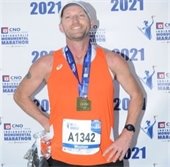
Once he’s finished the race, collected his medal and eaten his cheeseburger, Matt says he’s not sure what’ll be next.
“People have been asking me, ‘Are you done? Is this your last marathon?’ I honestly can’t answer that question,” he says. “I crossed the finish line twice and said I’m never going to do this again; and I’ve crossed two times and said when’s the next one?”
He does think he’ll dial the training back a bit. “I won’t stop running. It’s too much of a stress reliever for me,” he says. “Unless I get injured, but knock on wood …” Aside from some plantar fasciitis early in his running career and some back spasms that once slowed him for a few weeks, Matt has remained injury free.
So how does a healthy, 49-year-old man challenge himself after the Boston Marathon? Matt says he’s been interested in bikes lately and is considering maybe a duathlon (a race that consists of running 6.2 miles, biking 24.8 miles and then running 3.1 miles).
Two of Matt’s running buddies – Craig Frye and Jason Burlage – have both completed IRONMAN competitions, which consist of a 2.4-mile swim, a 112-mile bike ride, and a 26.2-mile run. Is that something he might consider next?
“No,” Matt says. “That’s a hard no. And if you see Burlage, you can tell him I said hard no. That has never really crossed my mind other than to say, ‘Man, that’d be cool.’”
But isn’t that how these things always begin?
“Don’t start that,” Matt says, laughing. “I’ll go home and tell my wife, ‘Alright, a guy challenged me at work. He doesn’t think I can do an IRONMAN.’”
Matt will start the Boston Marathon today at 10:30 a.m. You can follow his progress with the official Boston Marathon app, available at https://www.baa.org/baa-mobile-app. His bib number is 12388.


 Share on Facebook
 Share on Twitter
 Share via Email
