The Little Zap that Saved a Life Mike O'Bryan and Anne Wolking weren't very
close until they shared a kidney
|
|
|
|
|
|
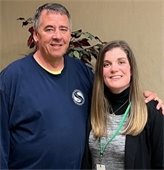
Mike O’Bryan and Anne Wolking knew each other back in the winter of 2019, but it would have been a stretch to call them friends. They had been co-workers at Sanitation District No. 1. They’d shared an occasional hello as they passed in the hall or rode the elevator. They’d connected on Facebook, but that was about it.
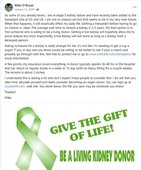
Then one day Mike, who still works at SD1 as an engineering inspector, made a post that got Anne’s attention: He was in stage 5 kidney failure, preparing for dialysis.
Mike has polycystic kidney disease (PKD), a hereditary disorder in which clusters of cysts develop primarily within the kidneys, causing them to enlarge and lose function over time. A normal kidney is the size of a fist; his are the size of footballs.
Mike’s mother died from the disease in 2016. His brother and sister both have it, as do other members of his family. And by January 2019, his condition had gotten dire.
“I was not at the sanitation district anymore,” Anne says. She had started at SD1 as an intern and stayed on as a communications specialist for 11 years, departing in 2017. “I was at my current job (project management coordinator at PublicSchoolWORKS). We were friendly, but we were never in the same room where we had to work together consistently. So, I knew of Mike,” she says, “I just didn’t know him.”
But as she read his Facebook post, that didn’t matter.
“The very first moment that I got his post I got that little – it was like a little zap I guess,” she says. “Like hmm … that’s weird. I feel like maybe I’m supposed to give this man my kidney. There had been other instances in my life where I thought maybe it was time, but I’d never gotten more than the idea that it’d be cool to do. But it was in that moment that I knew, ‘This is your yes. This is it.’”
Anne has no question what the zap was. “That was God,” she says. “That was just this innate … I knew that it was a direct ask for me to give my kidney to this person.”
The thought didn’t occur out of the blue. Anne says she has always felt drawn to kidney donation. She recalls when a college classmate donated a kidney to her 2-year-old son. Several years ago, one of her cousins donated a kidney to her uncle. Even dating back to high school, she remembers conversations with her parents about WLWT news anchor Lisa Cooney donating one of her kidneys.
“At that point, living kidney donation was so not discussed the way that it is now, and I still think it’s not discussed how it should be,” Anne says. “But back then, as a teenager, hearing your parents talk about how scary it was for Lisa because she had her whole life ahead of her … you just don’t know what you don’t know.”
Anne says that’s what got her thinking. “It’s not scary,” she says. “You’ve got two. And that’s the matter of fact: Kidney donation is not dangerous, especially in the Greater Cincinnati area, with one of the top programs.”
But even so, making the decision to donate a kidney to a former co-worker wasn’t easy. Her husband, Doug, was about to change careers, so the timing wasn’t optimal. “I played the timing game,” she says. “I told myself if my husband gets the job, then clearly it isn’t the right time for me to give a kidney. And if he doesn’t, then it’s a sign.”
She says as she waited for a sign, other people came forward to get tested. Mike guesses that seven or eight people went through the testing process to see whether they were a potential donor match. “I told myself maybe I’d misjudged the zap,” Anne says. “Maybe I was just wanting Mike to get a kidney.”
But other potential donors fell through, and it started to look like her husband would get the job. He would soon be enrolling in a police academy in Eastern Kentucky.
“But we were sitting in church and I kept hearing in the back of my head, ‘It’s not about your timing. It’s not your timing.’ And so I looked at Doug after Mass and I said, ‘I know you’re getting ready to leave for the academy, but Mike is getting my kidney and I need to get tested.”
Before that could happen, though, Anne says she had another important hurdle to clear. “I have three kids and it was important to me that my kids knew what was happening and if they kiboshed it, that was it. If they said no, that was it.
“So we explained to our children what was happening, who Mike was and what the process was going to look like. And my oldest, Deacon, who was 11 at the time, said, ‘So Mike is sick and he needs a kidney to be better?’ And I said yes. And he said, ‘And you have two kidneys and only need one?’ And I said yes. And he said, ‘And if you give one kidney, you will still be healthy.’ I said yes. And he’s like, ‘Well the answer is yes.’”
That sealed the deal.
|
|
|
|
|
|
“I just think as adults we pine over the most minute of details,” Anne says. “And to hear it come from an 11-year-old, that amount of wisdom. To him, this was a very solvable problem. Of course the answer would be yes.
She soon after started the screening process, which is designed to test much more than just whether your kidney will be a good match.
It’s almost like Donor Olympics. The prospective donor goes through the most intense physical of their life, complete with an EKG and chest X-ray. They have blood drawn, collect a 24-hour urine sample and meet with a nephrologist, surgeon, social worker, and psychologist. The process is designed to ensure that a donor is mentally, physically and emotionally prepared to donate.
The process makes sense when you think about it. Live organ donation is, after all, an elective procedure. If Anne went through with it, she would have to live with one kidney for the rest of her life.
“It’s actually really reassuring,” she says. “You should feel very confident when you do decide to donate because you’ve got a whole team of people working to make sure it’s safe.”
As Anne went through the process, Mike was making preparations to begin dialysis. Without a new kidney, he would be hooking himself up to a machine for eight hours every night – seven days a week. The machine would pump him full of fluid which, like pouring sugar on a strawberry, would extract the toxins out of his body. Two cycles per night for the rest of his life.
Three days before he was scheduled for surgery to have his dialysis port put in, he got the call that a donor had been identified.
“When they called me, they said the person who is donating will let you know in their own time, but they can’t do it right now,” Mike says.
There were a couple of reasons Anne wasn’t quite ready to tell Mike she was the potential donor. First and foremost, it is an elective procedure, and if Anne decided she needed to back out for some reason, she didn’t want to hurt Mike. She also didn’t want to paint herself into a corner. Plus, she’d seen several other potential donors fall through and she didn’t want to set him up for disappointment.
“And besides, what a freaking awesome surprise to be able to give that to a person unsuspecting,” she says. “So selfishly, I was wanting to surprise him a little bit.”
A few days later, Mike got a call from the SD1 Human Resources department to set up a meeting to discuss insurance issues related to the procedure. “It was the first thing in the morning on Aug. 15,” Mike says. As he recalls the moment, his emotions begin to get the best of him. His voice cracks. “They called me down to the training room and she was in there,” he says.
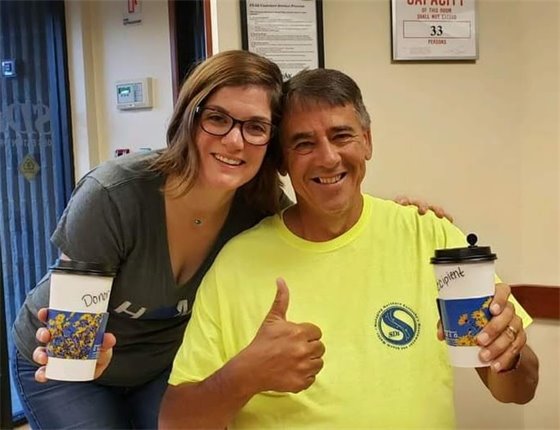
Anne had stopped and bought two cups of coffee. On hers, she had written “Donor” and on Mike’s “Recipient”.
Tears stream down Mike’s face as Anne talks about that morning. “I was excited,” she says. “And I was incredibly nervous.” They sat and talked for an hour about the journey ahead.
“I’m trying to think of the right word,” Mike says. “Just amazed that somebody would do that. Again, we were friendly but we weren’t close. She didn’t know anything about my family and I didn’t know anything about her family. So for someone to step up and do that – it takes a special person.”
Mike canceled the surgery to install his dialysis port, and less than a month later, they were on operating tables at UC Health.
“First of all, we wanted to try to get him in before he even had to go on dialysis,” Anne says. “That was just a fun little bonus. But I had no idea that he was that close.”
Anne says her work schedule and her husband’s new job left them two options for surgery: September 2019 or March 2020. “For so many reasons, I thank God we went with September,” she says, noting that the surgery might not have been possible in March because of the COVID-19 pandemic.
“I look back on it and the timing of everything – the way everything fell into place, it’s amazing,” Mike says.
Sept. 9, 2019, is a day neither is likely to forget.
“We saw each other beforehand,” Anne says. “I remember I went over and hugged him. And I do recall, as I was getting wheeled away, I was feeling really good with the medicine.”
“Not when you passed me you weren’t,” Mike says, laughing. “You were bawling.”
Mike’s wife, Marsha, told Anne that they would have no hard feelings if she decided not to go through with it, but one of Anne’s sisters reassured them that’s not what Anne’s crying was about.
“When you went by and were crying so hard,” Mike says, “your sister looked at me and whispered, ‘Those are tears of joy.’”
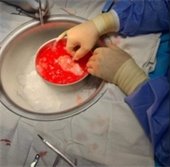
Anne’s procedure was first and lasted about an hour and a half. “Mine was super simple,” she says. “They do what’s called a hand-assisted laparoscopic nephrectomy, where they basically make an incision on your stomach and then two laparoscopic incisions, and the surgeon takes his hand up that hole in my stomach, snips the kidney and then guides it down with his hands out of my body.”
Her kidney went immediately into an ice bath and then over to a waiting Mike. It would take another couple of hours to insert and connect the kidney. Mike had learned from a poster on the wall at his dialysis training that they don’t remove the cystic kidneys unless they are causing issues. His weren’t, so Mike now has three.
As Anne waited in recovery, word came in that Mike had peed while still on the table. It was the best news possible. “When you get a cadaver kidney,” Anne says, “sometimes it takes the kidney a while to wake up and so it doesn’t immediately produce urine. Mike’s kidney expelled urine as soon as they hooked it up. That’s a very good thing.
“And it was the largest female kidney the surgeon had ever seen,” Anne says, laughing. “Mike got a winner of a kidney.”
Anne says she recovered quickly. And even though her husband had to leave for the police academy just two weeks after the procedure, she says, “I had lots of family – I’m one of eight – and amazing neighbors.
“And the moment that I told Mike was also the moment that I received a new family. And so I got the immediate support of Mike and Marsha and their son Tyler. I was contacted by his brother Pat, his sister Laurie. I was immediately covered in love by people I hadn’t even met yet. So it was just the right decision, and looking back with hindsight, it was absolutely the right decision to do it the way that we did. And he got to get his new kidney without dialysis. Not one session.”
Anne admits she felt like “absolute hot garbage” for about a week and was sore for a couple more, but says after six weeks, she felt like her normal self again.
It’s been two and a half years since the surgery and Anne says she often forgets it even happened. She still plays soccer, runs, goes to the gym three to five times per week.
“Nothing has been limited by my choice to donate,” she says, noting that she does keep an eye on alcohol intake and makes sure to drink at least 64 ounces of water each day. “Largely, everything else is the same.”
Mike, meanwhile, missed three months of work, mostly due to having no immune system. They virtually eliminate your immune system so that it doesn’t reject the new kidney. He says he was sore for two or three weeks and then felt normal again.
Both Mike and Anne credit a higher power.
“When you look at all of the puzzle pieces,” Anne says, “you can’t deny that there was something outside of our control directing this whole thing, which makes it really cool.”
Mike agrees. “Absolutely, I’ve got no doubts,” he says. “The blessings that I’ve received through all of this are just crazy. There is no other way to explain it. My mom passed away from this [in 2016]; I’m pretty positive she had a lot to do with it.”
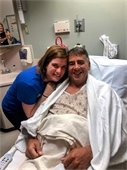
Anne says one of her most emotional moments came when she visited Mike in the ICU. “I think the thing that hit me the hardest,” she says, “I knew what was happening was important, clearly, because of the quality of life for Mike, but I think the thing that broke me down was… ”
Mike is crying again as Anne continues.
“… when I got to visit him for the first time,” she says. “You’re allowed two guests, and so it was Marsha and Tyler, his wife and son. Tyler, who was 26 years old at the time, stepped out so that I could go in and see him. And Tyler looked at me and broke down and said, ‘Thanks for saving my best friend.’
“And that was when I realized that it was way bigger than just one person,” she says. “It was way bigger than just me and Mike. I was giving the opportunity for more birthdays, more Christmases, more golf outings with a son and margarita nights with neighbors.”
She said after the procedure, the little mundane moments that people often take for granted don’t seem mundane anymore. “Those moments are now a gift,” Anne says.
Today, Mike and Anne are more than just friends – they’re family.
“I think that COVID kind of put the damper on us fully integrating as a family, but he’s got the invite to all of our family gatherings,” Anne says. “I think the coolest story is – while he and I were both under, having our surgeries, it was the blend of my husband’s family, my family and his family – they all just came together. They’re just a regular part of my life now.”
Mike and Anne are messengers of hope for others waiting for an organ donation.
“Anne and I want to spread as much news about it and awareness as we can,” Mike says. “We were set up to go and talk to high schools about it, but then COVID hit and really this is our first opportunity together to tell our story and have people listen.”
Anne says she’s always happy to share her experience with anyone considering donating an organ. “That’s the hard part about living donation,” she says. “When you try to do research from a donor perspective, there’s not much out there. Generally speaking, people who donate are not ones to wear it on their sleeve. We generally just go about our day as if it didn’t happen. Because largely, I forget that I only have one kidney. That is how normal my life is. The caveat is, on the internet, there is not a lot of perspective from the donor.”
She strongly encourages anyone who feels that little zap to lean into it. “Talk with a living donor advocate at the hospital and ask if there are donors who would be willing to talk about it,” she says. “Ask questions and get curious.”
Mike says he’s always eager to share as well.
“I want to stand on the highest mountain and tell everybody our story and what it meant to me and obviously what it means to Anne,” Mike says.
April is National Donate Life Month. For more information about organ donation, visit https://www.donatelife.net/ndlm. |
|
|
|
|
|
Register Now for Truist Momentum
We’ve officially launched SD1 Financial Well-Being, SD1’s bold new financial confidence program available at no cost to all staff.
We are encouraging staff who weren’t able to attend an information session to check out the Truist Momentum tab on the Pipeline for details about the program (including a full video of an SD1 Ignite session), and then follow the simple steps below to create an account and start working through the program’s videos, modules and activities.
Get started by following these simple steps:
- Go to www.TruistMomentum.com
- Enter your name and email address
- Enter the registration code: SD1
- Enter a unique password and click “Register”
You’re all set! Start working through the videos, modules, and activities on the My Education page!
|
|
|
|
For Those About to Rock...
Do you play guitar, drums or some other musical instrument? Are you a pop diva in the shower or the car? We're looking for SD1 staff who have what it takes and are willing to put it all on the line in a friendly competition with coworkers. If you're interested, contact Chris Cole.
|
|
|
|
STAFF BIRTHDAYS
We've got a few staff members celebrating a birthday this week!
April 5 - Jonathan Fletcher, Facilities
April 10 - Matthew Wooten, Planning
April 10 - Mark Andrew Groger, Asset Management
April 10 - Derek Hunt, IT
Be sure to wish then a happy birthday on their special day!
|
|
|
|
SPLASH WANTS YOUR STORY
Splash is always looking for story ideas! If you or a co-worker has an interesting side hustle or hobby, a unique skill or a great anecdote to share (maybe you had a fun run-in with a celebrity or a hilarious mishap while traveling), send it along to Chris Cole at ccole@sd1.org and he will be sure that Splash sees it!
|
|
|
|
|
|
|


 Share on Facebook
 Share on Twitter
 Share via Email
