Heritage is defined as “property that is or may be inherited,” but the word means so much more than that. It’s a roadmap for who you are and where you came from. It shapes a person’s identity and connects them to generations past.
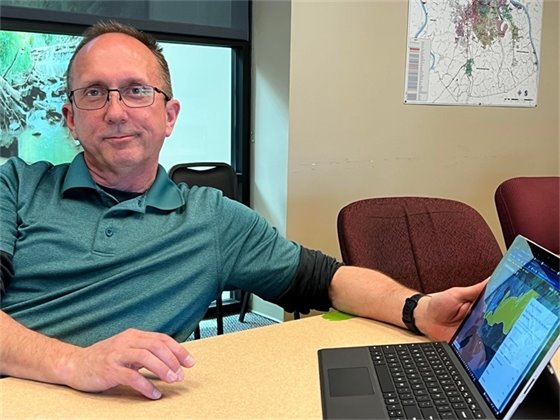
Dane Boggs grew up without a heritage.
The Sanitation District No. 1 IT manager knew he was born in Hawthorne, Calif., and was adopted when he was just a few days old. His adoptive mother was always upfront with him about that. But that, along with the name of his biological mother, was all he knew.
“I didn’t know anything about my biological family,” Dane says. “My adoptive mom told me the information that she did have, which was primarily the name of my biological mother. But she didn’t have any reason why I was put up for adoption or anything like that.”
He was raised in a military family that moved around a lot, so tracking down his mother – particularly in the days before the Internet, was impossible.
Being adopted never bothered Dane very much, but he was always curious about his heritage. Often times he considered taking a DNA test to learn what he could about his makeup, but the process was costly, and he wasn’t sure it would be worth the effort.
“So I always wanted to know, basically, what my ethnicity was,” he says. “I couldn’t say for sure that I was German or Swedish or whatever. And I thought that would be good.”
As the cost of the ancestry tests dropped below a hundred dollars in 2016, Dane decided it was time.
“I thought maybe I’d treat myself and do this,” he says. “At the tail end of 2016, I hopped on an Ancestry.com sale and bought a test. I received it in the mail, spit in a tube, put it back in the envelope, sent it back to Ancestry and forgot about it for a couple months.”
In January 2017, he received the results, and they were split right down the middle between Eastern Europe and Western European. As he continued to study the results, he made an interesting discovery.
“I really didn’t take the test so I could actually meet my biological family,” he says, “but low and behold, I had what I’ll call a match in my profile that was very strong.”
Ancestry.com uses a quantitative value called a “centimorgan” (CM) that measures the strength of genetic commonality between two people. The higher the CM score, the more you have in common with someone.
So for instance, the average CM score between a person and their first cousin is 874; the average score for someone and their sibling is 2,629. Anything over 60 suggests some genetic material in common.
As Dane looked through his genetic matches, he came across someone with a CM score around 1,700. Dane figured he’d found a first cousin. He sent an Ancestry message to the match with the subject line, “Hey there cousin” and waited.
A couple days later, a man who lived in San Francisco replied that he was actually a genealogist himself, and he was pretty sure he had everyone accounted for in his family tree.
“I think he was very skeptical at that point and was afraid that I was some kind of scammer or something,” Dane says.
Dane sent the two pieces of information he had – where he was born and the name he’d been given.
Four days later, the man replied again. “He wrote back and said the information I’d sent had blindsided him,” Dane says. “He said when he read my email, he locked himself in his bedroom for several hours to ponder what I’d sent.”
“In my email, I’d asked him if the name sounded familiar,” Dane says. “He responded, ‘Yeah – that name sounds familiar because that’s my mother.’”
For years Dane had searched for a married name that his biological mother actually hadn’t used in many years. As he and his Ancestry match talked through the implications, they soon realized they were not cousins after all, but rather half-brothers.
“I had never met any blood relatives before that time other than my own sons,” Dane says. “That was it. And now, all of the sudden, I had this rather extended biological family on my mother’s side.”
Suddenly, Dane had two half brothers and three half sisters, all on his mother’s side of the family. He discovered that of six children, he was the only one given up for adoption. His Ancestry match in San Francisco was the youngest child.
As finding biological families goes, Dane was lucky. “We hit it off well,” he says. “That doesn’t always happen with the results of genetic tests. I was very fortunate in that instance.”
Dane says his half-brother was a fountain of information.
“He gave me the family tree that he had; he gave me a ton of photos that he had,” he says. “So I went from having nothing to having this vast amount of information about my biological family. Both sisters reached out to me and I’m in regular contact with my oldest sister.”
A few months later, his half-brother visited Cincinnati and spent a few days with Dane and his family. “That was great,” Dane says. “I got to hug somebody who was biologically related to me. So that was good.”
But there was still a missing piece of the puzzle. Dane had found his biological mother, but the other half of his heritage was still a mystery. He took a test to measure paternity relationship with his newly found half-brother, and there was no connection.
“So we were definitely related – we had the same mother but we definitely had different fathers,” Dane says.
He decided to upload his genetic information to a website called MyHeritage, and in January 2018, he got a hit match that had an even higher CM score than his half-brother. He had found another half-brother, only this time on his father’s side.
“Turns out he’s a few years older than me and lives in Portland,” Dane says. “We talked and he said his mom and dad had split up when he was very young, but he knew he had a brother. And he only had a name. And he told me the name and it pretty much floored me.”
Dane’s brain was racing when this new match in Portland told Dane the name of the man he believed to be his father. It was the very same man who was the father of Dane’s half-brother in San Francisco.
“It’s crazy man,” Dane says.
The implications were staggering. It meant the man and woman who had raised Dane’s half-siblings in San Francisco were actually his biological parents.
But that wasn’t the end of the story. Something just didn’t add up.
If Dane’s half-brother in San Francisco shared a biological mother and father with Dane, his CM score should have been much higher, as they’d be full biological brothers. And the half-brother in San Francisco should have also shared significant genetic commonalities with his half-brother in Portland. But he didn’t.
So as Dane discovered his biological father, his half-brother in San Francisco would eventually discover that the man who had raised him and called him son was actually not his biological father.
“My wife and I had some really soul-searching discussions about [whether to tell his half-brother],” Dane says. His biological mother and father had raised the man as their son and even lived the last 10 years of their lives with him.
“They were a very close family,” he says. “I said I don’t think I can do this to him, so I decided to just leave things as they were.”
But his half-brother was an experienced genealogist, and it was only a matter of time. Dane received a call in May from his half-brother in San Francisco. “I’ve gotten some recent hits on Ancestry,” he told Dane, “and I’m starting to think that [his dad] might not be my father.”
With so many crossed connections, it can be difficult to keep things straight.
Dane points out that his biological father is “dad” to his half-brother, as the man who raised him and loved him. “He and I have talked in depth about this – about how heartbroken he was. I told him, ‘That man is your dad, he’s not my dad. I have my own dad – the man who adopted me.’ I said, ‘My biological father will always be your dad. He loved you as a son and you were his son.’”
Dane’s heritage began to come into focus. He had ancestors from Norway, Germany and northwestern Europe on his mother’s side and from Poland and Russia on his father’s side.
He’d eventually learn that his biological mother had been married to a “bad dude” who was serving time in San Quentin State Prison when she met and fell in love with another man. When she became pregnant, she worried for the safety of her child and so she gave the child to a coworker (Dane’s adoptive mother).
Dane says that while he’s disappointed that his biological mother and father passed away before he did his ancestry test, he is comforted to at least now know who they were.
“When you don’t know – you have these big gaping holes in your heritage,” he says. “Actually, I had more than gaping holes; I had no heritage at that point. This gives me roots I think. It lets me know both ethnically where my heritage comes from and also from a human standpoint. I’ve even seen a couple video clips of my biological mother; I got to hear her laugh.”
And Dane is fortunate – it turns out his half brother is a very good genealogist. He has information dating back 600-700 years.
“If you’re curious about your ancestry, especially if you’re adopted, and you don’t know what to expect, if you’re lucky, you’ll get a great, loving family like I did,” Dane says. “One that embraces you and takes you into the family. And you laugh and learn with them through the challenging times and you learn a lot about your beginnings. Your heritage, which I knew nothing about to that point.”
Thanks to a hundred-dollar DNA test, he now has two half brothers and three half sisters on his mother’s side and two half brothers on his father’s side to go along with a loving adoptive family.
“I’ll always consider my adoptive family as my family,” he says. “I now just have a bigger family. I don’t have a different family – I have a bigger one. I’ve added to my family. That’s one of the great things about this – I now have a family tree that I can provide my sons.”
If anyone would like advice on how to get started with their own Ancestry or MyHeritage adventure, Dane says he would be happy to discuss. His email address is dboggs@SD1.org.
 Share on Facebook
 Share on Twitter
 Share via Email
