Madison White can trace her fasciation with World War II and the Holocaust back to the third grade, when she read a snippet of The Diary of a Young Girl by Anne Frank.
“I remember thinking, how could something like this happen? How could we let this happen?” she recalls.
She posed those difficult questions to her family, and they were honest about the horrors of the war. “My grandparents grew up in the shadow of World War II, and I grew up in the shadow of 9/11,” Madison says. “That was something they didn’t really like to talk about, but they did like to talk about their parents’ lives during the Great Depression and during World War II.”
In fifth grade, despite warnings from her teacher that the book was above her reading level, Madison read the complete diary of Anne Frank.
In middle school, any time there was a history project, you could count on Madison to focus on World War II or the Holocaust. In sixth grade, she created a presentation on Frank for her school’s history fair, recreating the burgundy book cover in a tri-fold poster presentation.
“It was just one of those things because adults would talk to be about it,” she says. “They never really tried to hide it – even when I was just a kid. They figured I deserved to learn from first-hand experiences about one of the most defining moments of humankind. And ever since then, I was hooked in a really weird way.”
Fast forward to the year 2019.
Madison was studying human geography at the University of Cincinnati, minoring in history and political science, when she came across an ad for a special class that would be offered through the electronic media department in the College-Conservatory of Music.
Associate Professor Hagit Limor, an Emmy award-winning television journalist, would be leading a group of students to Europe to study the Holocaust through the lens of Lamor’s father, Moniek, who spent a year at the Buchenwald concentration camp before being liberated by American troops in 1945.
“The poster said, ‘Do you enjoy learning and researching about the Holocaust? Do you enjoy seeing how movies are made? If so, this class is for you.’ I didn’t know much about making movies, but I did know a lot about the Holocaust, so I went for it.”
She was one of 90 applicants for the trip, which aimed to create a documentary about the experience, an immersive play and a podcast.
“I think Hagit was intrigued that a geography major would want to go,” Madison says. “Everyone else was an electronic-media, or history major and she asked me what I could bring to the table. I told her I know a lot about the movements – why everything happened from a geographic standpoint.”
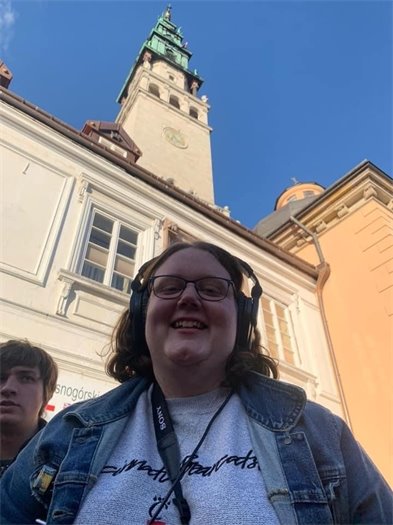
She was one of 15 students selected for the trip, and the group left for Europe (by way of Chicago and London) in October 2019.
The experience began inauspiciously for Madison in Warsaw, Poland, when she overslept on the first full day, waking up five minutes before the group was set to depart. She stuffed three or four bread rolls into her pocket and away they went.
They visited a piece of the wall surrounding what was the Warsaw Ghetto. “It was the craziest thing because all around this wall – such an important piece of history – you have these big skyscraper apartments. Hundreds of thousands of people were trapped behind this wall. Right then and there, we all knew that this was going to be heavy.”
They visited memorials for the Warsaw Uprising and the Warsaw Ghetto Uprising before hopping on a bus for Czestochowa, the hometown of Hagit’s father. When Moniek was just nine years old, Germany invaded Poland.
His family initially tried to flee to the country, but German bombs forced them back to their home, which was above the family business – a very lucrative company that attached the tops of shoes to soles.
That the boy was the son of a successful businessman was of little protection. Within a year of the German occupation, he had lost his father (who died from pneumonia after being dragged from his bed and forced to shovel snow) and a ghetto had been established to house the city’s large Jewish population.
“We saw the attic where Moniek, his mother and middle brother hid from the Germans,” Madison says. It was reminiscent of the book that had sparked her initial interest in studying World War II.
“That’s why we were there,” she says. “We cannot let the past be forgotten. That was always our biggest mantra.”
In a twist that Madison describes as “cruel yet merciful,” Moniek ended up developing Alzheimer’s Disease and had started to forget his own childhood memories. “That’s what spurred this project for Hagit – her father’s diagnosis.”
Madison said that visiting the places from Moniek’s life and taking in the suffering that a young boy experienced during the worst period of his entire life changed her.
“It taught all of us about being grateful for what we have,” she says. “I remember one day it was really cold because it was Poland in October, and we’re all shivering trying to get some video shots. And we were like, ‘At least we have coats on, because we know that half of these people didn’t have coats or any winter gear.’”
They visited the train station where Moniek’s mother and brother were loaded onto a train headed for the Treblinka extermination camp, in the forest north-east of Warsaw, where they were immediately sent to the gas chamber.
Moniek and his older brother were the only surviving members of his family, and they were forced to work at a rearmament factory there in Czestochowa.
“Every day they’d have to line up and it was a left/right situation – left meant death and right meant life,” Madison says. “Moniek was still a child, so he would pile up snow or rocks and stand on the pile to look taller. A random commander once saved his life by pulling him from the line and assigning him the job of tending to the geese at the commander’s house.”
She said the group followed a creek where Moniek once led the geese. “One of the things Hagit’s father had told her was how he’d lay in the grass next to this creek and look at the sky and dream of freedom.” She and her classmates watched as Hagit recreated the memory.
“It was another reminder to be grateful,” Madison says. “Despite whatever hardships we might face, they will never compare to what Moniek experienced.”
Madison was primarily responsible for recording sound on the trip, and she was also the project manager, charged with making sure everyone knew what they were doing. If any of the history majors had questions about history, they’d look to the lone geography major on the trip for answers.
“We explored the large ghetto and the small ghetto – because as time passed, the German occupiers cut down the section of town used for the Jewish population,” she says. “It was insane because people still live there, just going about their business.”
Madison recalls a story she heard while she was there. The German work camp had two shifts, with Moniek working one and his brother working the other. One day, the city was liberated by Russian troops. But while his brother was set free, Moniek was loaded on a train to the Buchenwald concentration camp in Germany, where he would spend about a year.
“It was just a weird coincidence – one was taken, and the other was not,” Madison says.
The last thing his mother ever gave to Moniek was a small pouch attached to a necklace that contained money and his identification papers. When he arrived at Buchenwald, they were taken by an SS soldier, and he never got them back.
After their time in Czestochowa, Hagit told the group that they could not study the Holocaust without seeing the very worst, so they departed for Auschwitz-Birkenau.
Madison’s demeaner changes as she describes her experience at the camp where an estimated 1.1 million people were killed during the Holocaust.
“I…that was…hard,” she says. “It’s still one of the hardest things for me to talk about.”
She says that before the group left for Europe, Hagit had a therapist come talk to them to help prepare them for what they were going to see.
“So, in my mind, I tried to tell myself it was research,” she says. “It was science. It’s just an assignment.”
But as she walked through the notorious Auschwitz-Birkenau gate (which is actually a replica – the original was stolen), it was no longer research. It was more than just an assignment.
“Everybody knows about the exhibits with the shoes and the hair,” she says. “There was…well…that…that’s where…uh…”
She says the room was dimmed purple to help preserve the material. “As I went up the steps – we had done the bottom half, which was small artifacts and different stories of families and children, and photos of people arriving at Auschwitz. But as I was walking up the steps and into the room with the hair, I maybe took three steps in there and I more or less lost it.”
Madison was helped out of the building as she began crying out, “I’m sorry!” She called her mom, who cried with Madison over the phone.
After she calmed down, she chose not to go through many of the rooms. “I don’t know if that’s something I regret not doing,” she says. “Sometimes I think about it and think I should have just done it, but I think in the long run it was better that I didn’t.”
She says that her reaction helped bring the group closer together. “It showed to everyone else that it was OK to lose control and cry and not be so stoic about it,” she says. “And afterwards, the feeling of family that I formed with these random students. These were people I probably would have never talked to. That was cool.”
After Auschwitz-Birkenau, the group flew to Frankfurt, Germany, en route to the Buchenwald concentration camp where Moniek was sent in April of 1944.
“It was just row after row of barracks,” she says. “Most of the buildings are gone now, having been torn down for bricks or lumber. All that remains are outlines of where buildings used to be.”
She says that at one point while they were filming 360-degree video for the immersive play in the middle of the surrounding forest, the group stumbled upon an old fence with a small placard that read “Bär” (the German word for bear).
“Our guide, an American PhD student doing research at Buchenwald, told us they had a zoo at Buchenwald for the officers and their families. So, when they took their lunchtime walks, they could walk around the zoo and enjoy the animals.
“That was one of those things that stood out to me,” Madison says. “Not even 10 feet from the zoo are barbed-wire fences holding hundreds of thousands of people in captivity just like the animals. And the animals were treated better.”
Madison reflects on her time at Buchenwald. “When they’d get off the train, she says, “they’d be marched along this path. And there would be German shepherds and sometimes even townspeople there hurling hateful speech toward these people.”
She says they’d be marched to a building where they’d be stripped, shaved, dipped in a green delousing liquid, and tattooed with their number. Moniek used to tell Hagit about how much the green liquid burned.
He got sick not long after arriving at Buchenwald, developing a bad fever. His fellow Polish prisoners protected him and got him to the medical clinic, where he was treated. Once he got better, Moniek helped clean up around the camp. Many in his little Polish clique were involved in a resistance group that held its meetings in the camp latrines (too disgusting for guards to search), but he was only 13 or 14 years old, and so he didn’t take part in the resistance efforts.
Moniek was at Buchenwald until April 1945, just months before the war ended. The first time he ever saw an American soldier was when they were liberating him. In the end he was reunited with his older brother.
Now a UC graduate and a geospatial data scientist at Sanitation District No. 1, Madison has been accepted into the Masters in GIS Science program at Marshall University. She said she’s grateful for the SD1 education assistance program.
She also says she can’t help but recall her trip to Europe when she watches the news these days.
“It’s crazy,” she says. “When you’re learning about World War II and aggressive expansion and colonialism even, you always sit there and think – not in my lifetime. Especially not in my lifetime. We live in a more modern world. You don’t expect to see it. So, when I heard about Ukraine, my first thought was OK, what do we do?”
She says like most people around the world, she struggles with balancing her compassion for the people of Ukraine with the fear of starting World War III.
“Everybody wants something they can’t have,” Madison says. “And Russia wants something it shouldn’t be able to have. I feel proud of the Ukrainian people, though, for holding their ground.”
She says she also feels bad for Poland, Ukraine’s neighbor to the west. “They’ve only had like 20 years of peace in their entire history as a nation,” she says.
“I hope for peace,” she concludes, “but peace is fleeting.”
To view the documentary and additional resources, visit The Pipeline.


 Share on Facebook
 Share on Twitter
 Share via Email
