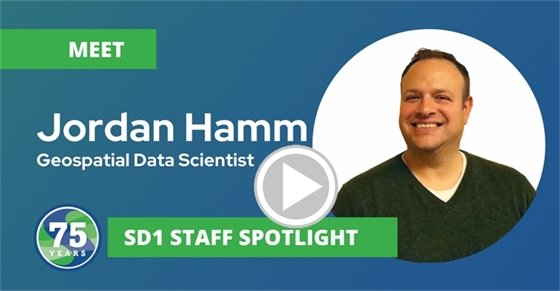
Meet Jordan Hamm, an SD1 geospatial data scientist. In 1999 Jordan began his career as a co-op in SD1's engineering department. Since then, his career has evolved into an analytical role in GIS (geographic information systems).
We sat down with Jordan to discuss his career and role in providing the region with reliable wastewater and storm water services.
Jordan, why did you choose to work at SD1?
In a way, SD1 chose me. As a senior in high school, my teacher came to me with a co-op position at the sanitation district, and I said, "What's the sanitation district?" Well, I soon found out, and 22 years later, I'm still here.
How did you get involved with GIS?
My first job in the engineering department was to feed maps into a copier for four hours a day, and I thought it was the greatest job. Over time, my manager taught me about GIS, and I became a GIS technician and so on. Those opportunities gave me the foundation of my GIS career, so I'm very grateful to all the people who made that possible.
Tell us more about GIS. How would you describe it?
GIS is a marrying of data and maps. It improves analysis, decisionmaking, communication and the reliability of SD1's services.
Years ago, people thought GIS meant maps, maps maps. This is partly true because our job involves creating maps, but that's very surface level. Ultimately, SD1 users need accessible and reliable data to make good decisions, and GIS is the backbone of that effort. We take the data from our hardworking field crews, house it, maintain it and preserve it for the use of others. Other SD1 departments reference and rely on this data to make important decisions for the utility and region.
What does your role involve?
For a long time, my job involved putting wastewater and storm water structures on maps and giving them attribution, but my current role is more data-analytical and it consists of maintaining the storehouses of that data. I look behind the scenes to ensure things are functioning properly so our users can access what they need seamlessly.
What is the most rewarding part of your job?
The most rewarding part is helping others. My customers are internal, so a colleague may come to me and say they have a problem or a need. I use the tools I have to help them solve their problem or give them enough information to make the best possible decision. It's always satisfying helping others and problem solving.
What about the challenges?
A challenging part of GIS in particular is the ever-changing technology. GIS is constantly evolving, and we often say we're only scratching the surface when it comes to what we even do here at SD1. It comes down to using these tools wisely and communicating. It's important never to say, "I'm too busy, or that's too challenging." We have to embrace the challenge to use the tools already available for the success of SD1.
What advice would you give someone starting a career in GIS?
I'd say be patient with yourself and the technology. There are a lot of different pathways a person can go down while pursuing a career in GIS. If someone pays attention to detail and is willing to listen, learn and take directions, all of that will lay the foundation for a successful GIS career.
What do you like to do outside of SD1?
I am involved in a volunteer ministry to help others and talk about good news instead of all the bad news we see, which is enjoyable. I love spending time with my wife and my son - they are my life. And then spending time with all our wonderful friends is great.
What is your favorite part about SD1?
It's easily the people. There are many individuals here who are talented and skilled at what they do, so it's a joy to work alongside them and learn from them.

 Share on Facebook
 Share on Twitter
 Share via Email
